
Top 3D Printing Trends Shaping Industries in 2026
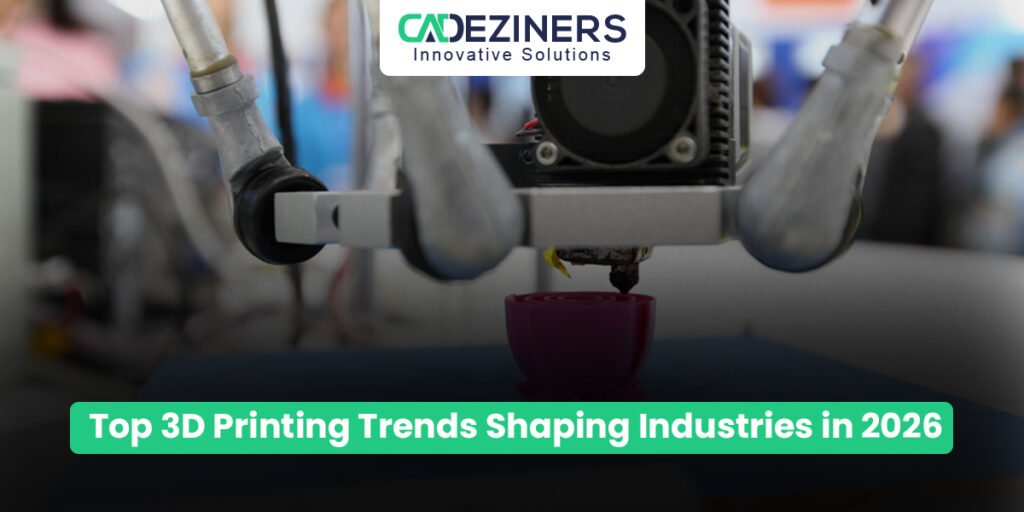
As we approach the end of 2025, additive manufacturing has firmly transitioned from a niche prototyping technology into a cornerstone of modern production. Current 3D printing market trends indicate a global market valued at approximately AUD 45.59 billion in 2025, with reliable forecasts pointing to AUD 55 to 56 billion by the end of 2026.
This sustained growth is driven by broader industrial adoption, falling equipment costs, expanding material portfolios, and increasing demand for customised, high-performance components. Manufacturers, engineers, and product development teams can now capitalise on shorter lead times, significantly reduced material waste, greater design freedom, and improved supply chain resilience.
In this guide, we explore the most influential 3D printing trends and future trends shaping industrial applications through 2026.
Multi-Material and Multi-Colour Printing Gains Mainstream Adoption
One of the most practical and immediately impactful developments among the current 3D printing industry trends is the widespread availability of reliable multi-material printing systems. Contemporary machines can seamlessly combine rigid polymers, flexible elastomers, soluble supports, and multiple colours within a single build without manual intervention.
Real-World Benefits for Manufacturers
This capability enables engineers to design and produce parts with integrated functional zones, such as soft-touch grips on rigid housings, vibration-dampening sections within structural components, or full-colour visual indicators for user interfaces.
By reducing the need for additional post-print assembly steps, this technology results in lighter final products, which enhance portability and ease of use. It also minimises potential failure points, increasing durability and reliability, while enabling faster production times, ultimately improving overall efficiency and customer satisfaction.
Improved Process Reliability
Recent advancements in nozzle-switching technology, material-purging routines, and chamber temperature control have markedly decreased cross-contamination and material waste during transitions. These technical improvements have enabled manufacturers to operate more efficiently and reliably.
Consequently, many New South Wales-based manufacturers are now confidently progressing from prototype validation toward mid-volume production of end-use parts, leveraging these sophisticated multi-material systems to ensure higher quality, consistency, and reduced manufacturing costs.
Metal Additive Manufacturing: Cost Reduction and Performance Gains
Metal 3D printing continues to mature rapidly. Binder jetting has become significantly more cost-effective for medium-to-high volumes, while refinements in laser powder bed fusion and directed energy deposition deliver denser parts with superior mechanical properties.
Hybrid Manufacturing Approaches
Hybrid workflows that integrate additive manufacturing with precision CNC machining are now routinely capable of achieving the tight tolerances and exceptional surface finishes necessary for demanding industries such as aerospace, defence, and medical devices. This innovative combination enhances manufacturing accuracy, quality, and efficiency across complex, high-performance applications.
Scalability and Material Expansion
The future of 3D printing in metals centres on faster build speeds, automated powder management, broader alloy compatibility (including high-performance titanium, nickel, and stainless-steel grades), and greater process repeatability. Companies adopting these technologies strengthen supply-chain agility and respond rapidly to engineering change orders.
For businesses seeking guidance on integrating advanced metal workflows, reliable 3D printing services in Melbourne can be the saving grace. We provide consultation, design optimisation, and production support to aid smooth transitions. Contact us to learn how we can help your projects!
Artificial Intelligence and Full Workflow Automation
Artificial intelligence has evolved into a crucial ally in the additive manufacturing process. AI-driven generative design tools produce organic, topology-optimised shapes that enhance strength-to-weight ratios while reducing material usage.
Intelligent Print Preparation and Monitoring
AI algorithms automatically determine optimal part orientation, generate efficient support structures, and fine-tune print parameters to maximise first-time success rates. In-process monitoring systems using high-resolution cameras, thermal sensors, and acoustic detection identify defects in real time.
End-to-End Automation
Robotic post-processing stations now handle support removal, surface finishing, and quality inspection with minimal human intervention. Predictive maintenance features reduce unplanned downtime, delivering consistent output at scale.
For manufacturers in New South Wales, these AI-driven improvements translate into shorter development cycles, lower scrap rates, and more predictable resource utilisation.
Commitment to Sustainability and Circular Materials
The layer-by-layer nature of additive manufacturing inherently produces far less waste than traditional subtractive processes. In 2026, this advantage is amplified by the growing availability of recycled filaments, bio-based polymers, and sustainably sourced metal powders.
Energy Efficiency and Closed-Loop Systems
Printer manufacturers continue to introduce energy-efficient platforms and closed-loop powder- or filament-recovery systems. These advancements help organisations meet increasingly stringent environmental regulations while preserving part performance.
Corporate and Regulatory Drivers
The combination of genuine ecological benefits and compliance requirements makes sustainable additive manufacturing a strategic priority for forward-thinking companies across multiple sectors.
Large-Format and Embedded Electronics
Large-format systems are gaining traction in construction, marine, rail, and heavy industry, where they produce oversized moulds, structural components, and production tools with fewer joints and improved structural integrity.
Direct Printing of Functional Electronics
Integrated electronic printing enables the embedding of conductive traces, sensors, heaters, and antennas directly within polymer or composite parts. The result is fully functional, ready-to-use smart components that eliminate many traditional assembly steps.
Protecting Intellectual Property in a Digital Manufacturing Era
As production files move freely across global networks, robust digital security becomes essential. Encrypted file transfers, secure cloud platforms, granular access controls, and blockchain-inspired tracking systems protect valuable designs from unauthorised use or counterfeiting.
These measures enable secure distributed manufacturing models, allowing sensitive components to be printed locally while maintaining strict control over proprietary intellectual property.
Final Thoughts
The 3D printing future trends shaping 2026 paint a picture of a mature, production-ready technology ecosystem. Multi-material versatility, cost-effective metal processes, AI-powered automation, genuine sustainability improvements, large-format capabilities, embedded electronics, and strengthened digital security collectively empower businesses to innovate more quickly, produce more efficiently, and operate more responsibly.
Now is the right time for organisations across Australia to adopt new advancements. If your project requires precise results, a professional 3D printing service in Adelaide can deliver excellent outcomes. Get help with your next project today!
Recent Posts
-
 How the Entertainment Industry Uses 3D Printing for Faster Props, Costumes & Sets26 Feb 2026
 -
 The Environmental Impact of 3D Printing: A Practical Path to Carbon Footprint Reduction26 Feb 2026
 -
 Why UV-Protected 3D Printed Parts Are Essential for Outdoor Use in Australia26 Feb 2026
 -
 Why Aerospace Companies Are Adopting 3D Printing for Lightweight Components26 Feb 2026
 -
Top 3D Printing Trends Shaping Industries in 202627 Jan 2026