
Rapid Repair and Replacement: 3D Printing for Power Plant Maintenance
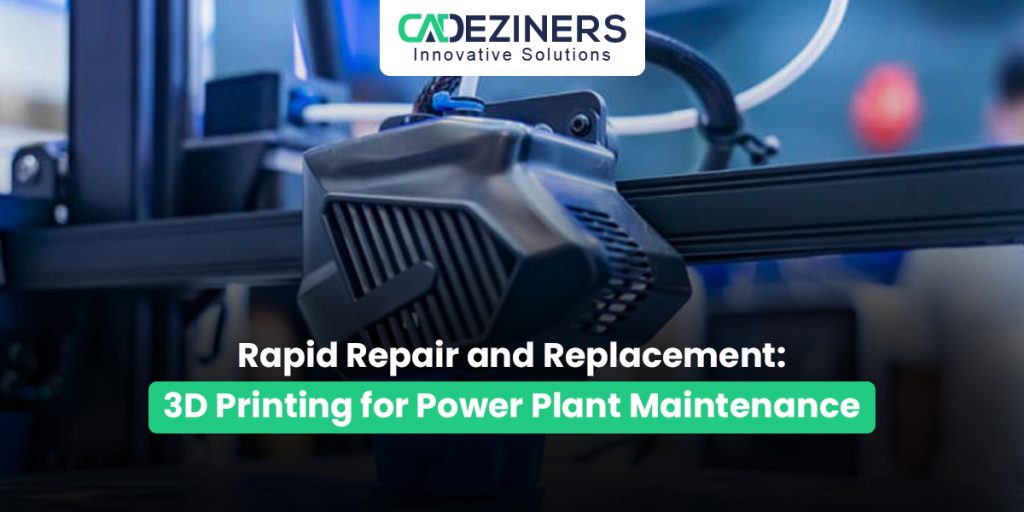
Unplanned equipment failures are among the biggest challenges for power plants. When turbines, pumps, or pipe fittings break, operations halt, costing both energy output and revenue. Traditional supply chains often struggle to provide quick replacements for specialised components, but additive manufacturing is changing that. Using this technology, engineers can now design, produce, and install parts within hours, rather than weeks. This shift supports faster power plant optimisation, minimises downtime, and extends asset life.
The Growing Need for Faster Maintenance
Power plants operate in demanding environments, high pressure, high temperature, and constant vibration. Even the smallest failure can affect output efficiency. Replacement parts for older machinery are often difficult to source, especially when OEMs discontinue models. Waiting for new parts means long outages and lost productivity.
This is where power plant maintenance supported by additive manufacturing becomes a game-changer. Engineers can replicate complex parts using 3D models, run structural simulations, and print replacements on-site or through a local manufacturing partner. The ability to print on demand reduces dependence on distant suppliers and helps plants stay operational even during supply chain disruptions.
How Additive Manufacturing Transforms Plant Maintenance
This printing technique offers a blend of precision, speed, and design flexibility that traditional manufacturing methods can’t easily match. Here’s how it’s reshaping power plant repair operations:
Rapid Part Production
When a critical component fails, waiting weeks for replacements is no longer necessary. Instead, technicians can scan the broken part, design a 3D model, and print it within a day. For non-critical parts such as valve housings, connectors, or sensor casings, printed replacements can be fitted almost immediately.
This rapid turnaround helps operators maintain uptime and schedule maintenance more efficiently.
Reduced Material Waste
Unlike machining, which cuts away material from a solid block, additive manufacturing builds parts layer by layer. This method minimises waste and reduces raw material costs. Many plants also use metal powders reclaimed from previous builds, creating a more circular and sustainable maintenance model.
Lightweight, Corrosion-Resistant Options
Modern additive manufacturing materials such as Inconel, stainless steel, and high-performance polymers can withstand extreme heat and corrosion. These lightweight yet durable components are ideal for long-term use in turbines, pumps, and cooling systems. The combination of corrosion resistance and weight reduction improves energy efficiency and helps extend maintenance intervals.
Streamlining Power Plant Optimisation Through Design Freedom
One of the biggest advantages of additive manufacturing is its ability to produce complex geometries that traditional casting or machining can’t achieve.
Consolidating Multiple Parts
Instead of assembling a pump bracket from several pieces, engineers can print it as a single unit, reducing joints that may fail under stress.
Improving Heat Transfer
Components can be redesigned to include internal cooling channels, improving temperature regulation and extending part life.
Adapting for Legacy Systems
For older power plants, this technology enables the reproduction of discontinued or hard-to-source parts, helping operators keep their equipment functional for decades.
This design flexibility contributes directly to power plant optimisation, as engineers can continuously refine parts for better efficiency and reliability.
Practical Use Cases Inside Modern Power Stations
- Turbine blade prototypes: Engineers can test blade designs for efficiency improvements before full-scale production.
- Pump impellers and seals: When a pump impeller cracks, printing a replacement reduces downtime from weeks to days.
- Custom connectors and housings: Perfect for instrumentation upgrades or retrofits in older plants.
- Tooling and jigs: Maintenance teams can print custom tools on-site for specialised repairs.
The Economics of Additive Manufacturing for Power Plants
Cost reduction is often the driving factor behind adoption. While initial printer investments are significant, long-term savings quickly outweigh the setup cost.
- Fewer supply chain delays: In-house or local production eliminates transport costs and customs delays.
- Lower inventory costs: Instead of stocking thousands of spare parts, digital files can be stored securely and printed when needed.
- Shorter downtime: Each hour saved during outages translates to significant financial gains.
A well-implemented additive manufacturing strategy can lead to a leaner, more responsive maintenance workflow that supports operational goals.
Sustainability and Lifecycle Advantages
Sustainability is becoming a critical benchmark for energy producers all over the world. 3D printing in Perth, Melbourne, and all over Australia contributes to greener operations in several ways:
- Less material waste: Layer-by-layer production consumes exactly the material needed.
- Reduced emissions: Localised manufacturing minimises freight-related carbon output.
- Longer equipment lifespan: Replacement parts printed on demand help maintain older systems instead of replacing entire units.
These advances align with global goals to make industrial operations more environmentally responsible, key to long-term ship sustainability innovations and similar engineering efforts across heavy industry.
Quality and Reliability Considerations
While the benefits are clear, safety-critical applications require careful validation. Additive components must meet the same or higher standards as traditionally manufactured ones.
Testing and Certification
Every printed part must undergo non-destructive testing, including ultrasonic inspection, hardness verification, and dimensional checks.
Process Repeatability
Consistent machine calibration and controlled environmental conditions are necessary to achieve repeatable results across batches.
Documentation and Traceability
Each part’s material batch, machine settings, and inspection records must be logged to maintain compliance and reliability records.
Industry regulators are already developing frameworks to integrate 3D-printed parts into energy production safely.
For example, engraving a deep design on raw aluminium requires higher power than engraving a fine logo on anodised aluminium. Operators often test small sections before final production to ensure the results meet expectations.
Bottom Line
Additive manufacturing’s role in industrial maintenance will keep expanding as materials and printers advance. Soon, full-scale metal components, turbine blades, and pressure vessel internals could be printed using hybrid additive-subtractive machines. The future power plant may rely less on warehouses and more on digital part libraries, driving both resilience and sustainability.
For maintenance engineers, this means faster recovery, smarter resource use, and higher overall plant performance, redefining how power plant maintenance is managed in the decades to come.
We help power generation companies move toward faster, smarter maintenance through additive manufacturing. Our experts specialise in reverse engineering, CAD modelling, and metal 3D printing for industrial applications.
Contact us today for 3D printing in Brisbane, Sydney, and all over Australia to explore how additive design can shorten repair cycles and improve plant reliability!
Recent Posts
-
 How 3D Printing Is Transforming Custom Medical Devices19 Mar 2026
 -
 The Advantages of Lightweight 3D Printed Components in Aerospace18 Mar 2026
 -
 What Makes Carbon Fibre Filament So Strong? A Look Inside the Material17 Mar 2026
 -
 Why 3D Printed Exhibition Models Are Essential for Trade Show Success16 Mar 2026
 -
 How the Entertainment Industry Uses 3D Printing for Faster Props, Costumes & Sets26 Feb 2026