
PLA vs ABS vs PETG: Picking the Right Material for Your Next 3D Print
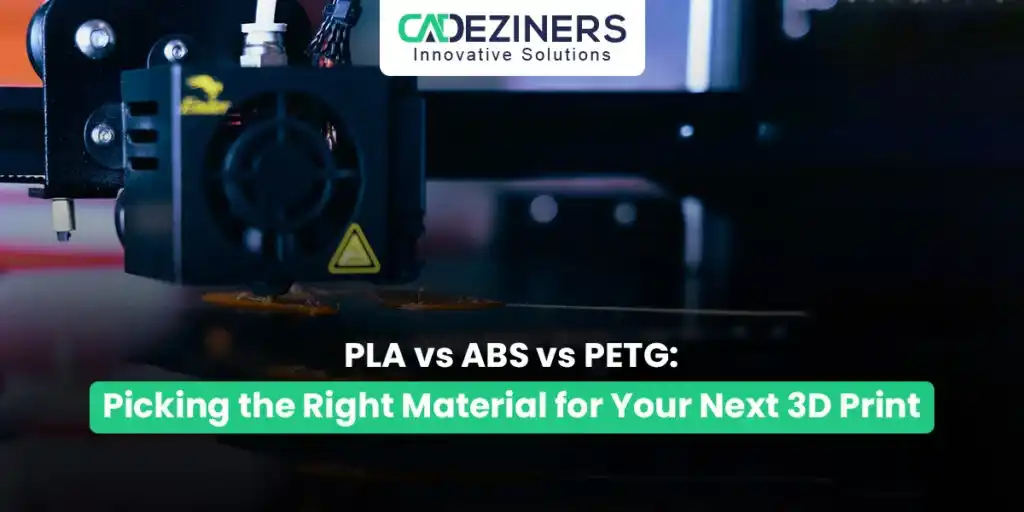
When you’re planning your next additive manufacturing project, one of the most important decisions you’ll face is choosing the right filament. PLA vs. ABS is often a starting point, but adding PETG makes the comparison even more relevant.
These three materials, PLA, ABS, and PETG, are among the most widely used in FDM 3D printing, each offering distinct properties that suit different needs. If you’re creating decorative models, functional prototypes, or durable parts, understanding their differences helps ensure your prints perform as expected.
Let’s explore what sets these filaments apart so you can select the best one for your work.
What is PLA?
PLA (Polylactic Acid) is derived from renewable feedstocks such as cornstarch or sugarcane, making it biodegradable. It is known for being user-friendly, making it a popular choice for many newcomers and hobbyists. This filament prints at relatively low temperatures, typically between 190°C and 220°C, and rarely requires a heated bed.
It produces minimal warping, low odour, and excellent surface detail, resulting in clean, glossy finishes. These qualities make PLA ideal for prototypes, artistic models, educational projects, and decorative items where appearance matters more than heavy-duty performance.
However, PLA has limitations. It exhibits high tensile strength but tends to be brittle, meaning it can snap under sudden impacts or bending stress rather than flex. Its heat resistance is also low; parts soften at around 55 to 60°C, so avoid using it near heat sources or in warm environments.
What Is ABS?
ABS (Acrylonitrile Butadiene Styrene) is a thermoplastic derived from petroleum, recognised for its durability and resistance to impact. It is the material used in numerous everyday items, such as LEGO bricks and vehicle parts. Compared to PLA, ABS offers better durability and higher heat resistance, with parts able to withstand temperatures up to 85 to 100°C before deforming.
It provides good flexural strength and elongation, allowing parts to bend slightly before breaking. This makes ABS suitable for functional items such as enclosures, mechanical parts, and tools, as well as for applications requiring structural integrity.
Printing with ABS demands more care. It requires higher nozzle temperatures (220 and 250°C), a heated bed (around 90 to 110°C), and often an enclosed printer to minimise warping from uneven cooling. It also emits fumes during printing, so adequate ventilation is essential. Despite these challenges, ABS remains a reliable choice when strength and temperature tolerance are priorities.
What Is PETG?
PETG (Polyethene Terephthalate Glycol-modified) bridges the gap between PLA and ABS. It’s a modified PET used in water bottles that combines ease of printing with enhanced durability.
PETG prints at temperatures between 220 and 250°C and benefits from a heated bed (70 to 90°C), but it warps far less than ABS and produces almost no odour. It offers excellent layer adhesion, chemical resistance, and transparency in clear variants. Parts printed in PETG are more rigid and more flexible than PLA, with superior impact resistance and moderate heat tolerance (up to about 80 to 85°C).
In the PLA vs ABS vs PETG discussion, PETG often emerges as the go-to for functional prints that require reliability under standard conditions. It’s widely used for mechanical components, outdoor items, protective cases, and even food-contact applications when certified as safe.
Property Comparisons: Strength, Durability, and More
When comparing these materials, mechanical properties are central.
PLA has the highest ability to resist pulling forces, with PETG coming close behind, and ABS slightly less. However, PLA tends to be brittle, which can limit how well it performs in real-world situations.
PETG vs PLA strength highlights a key difference: while PLA may win in pure tensile tests, PETG excels in impact resistance and flexibility, making it less likely to shatter. Parts deform rather than break suddenly, which is advantageous for many applications.
Durability and impact resistance favour PETG and ABS over PLA. ABS handles rough handling well, while PETG offers a strong balance without ABS’s warping issues.
Heat resistance sees ABS leading, followed by PETG, with PLA trailing significantly. For projects in New South Wales’ variable climate, where indoor temperatures can rise in summer, this factor often favours PETG or ABS.
Printability ranks PLA highest, followed by PETG; ABS requires the most setup.
The debate between PETG vs PLA is common among makers seeking better performance without sacrificing too much ease of use.
Choosing the Right Material for Your Project
Your choice depends on the specific requirements.
- For prototypes, models, or low-stress decorative pieces, PLA delivers excellent results quickly and affordably.
- If your part needs to endure impacts, moderate heat, or outdoor exposure, PETG often provides the best overall performance with minimal hassle.
- For high-temperature environments or maximum toughness in demanding applications, ABS is the preferred option despite its printing challenges.
Consider factors such as the printer’s capabilities, ventilation setup, and post-print requirements. Many users start with PLA to build skills, then transition to PETG for more robust projects.
If you’re looking for professional results without investing in equipment, 3D printing service in Sydney from us can handle complex prints using all types of materials, delivering high-quality parts for your designs.
FAQ's
Which material is easiest to print for beginners?
Is PETG stronger than PLA for functional parts?
Can ABS be used for outdoor applications?
Does PETG require special storage?
Final Thoughts
Selecting between PLA, ABS, and PETG comes down to balancing ease of use, mechanical performance, and environmental impact. Many makers compare PETG and PLA when they want better durability without sacrificing too much printability. Each material has earned its place in this technology for good reason, and understanding its strengths helps you achieve better outcomes. Take time to match the filament to your project’s requirements, and your next print will be stronger and more reliable.
For those seeking expert assistance with professional-grade prints in Victoria, consider our 3D printing service in Melbourne. We deliver reliable results with the right material for your project!
Recent Posts
-
 Traditional Props vs 3D Printed Props: Cost, Time, and Quality Comparison07 May 2026
 -
 How Strong Are 3D Printed Props for Professional Use?07 May 2026
 -
 Choosing the Right Material for Durable Stage Props07 May 2026
 -
 Best 3D Printing Technologies for Creating Props (FDM vs SLA vs SLS)07 May 2026
 -
 How 3D Printing Is Transforming Custom Medical Devices19 Mar 2026