
Introduction
Three suppliers. One CAD file. Three completely different numbers.
If you’ve just pulled quotes for a metal 3D printed part out of your inbox and the spread between them looks like a mistake, chances are it isn’t. This happens on nearly every job that goes out to more than one Australian supplier. One quote comes back at a few hundred dollars. The next sits well into four figures. A third lands somewhere in the middle with a lead time your project schedule can’t live with.
The reason isn’t that someone’s padding the price. It’s that each quote is really pricing a slightly different version of your part. Different machine time. A different build strategy. Different scope of finishing and QC. A different minimum charge. In some cases a different country. The number on a metal 3D printing quote hides a lot of moving parts underneath it, and if you’re not reading each one line by line, you’re usually not comparing like with like.
We walks through what you’re actually paying for when you order a metal AM part in Australia, why DMLS and SLM suppliers can produce the same bracket for three different prices, where offshore platforms start winning and losing on total cost, and how to pull apart any quote on your desk to work out whether the number makes sense. If metal 3D printing cost Australia feels like a moving target, that’s because line by line it is.
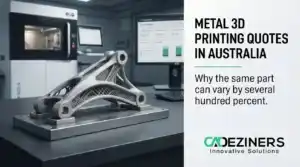
One-Minute Read
The short version: three Australian metal 3D printing quotes for the same part can vary by hundreds of percent because the three suppliers aren’t actually quoting the same job. Hidden underneath each headline figure is a different mix of machine time, build-chamber utilisation, support strategy, post-processing scope, QC level, minimum charge and country of production.
A few things worth knowing before you accept any quote:
- Machine time drives the number more than powder weight does. Industrial laser powder-bed machines are expensive to run per hour, so how your part fills the build chamber matters more than its mass. EOS and Nikon SLM Solutions, both of which build these machines, say the same thing in their published technical overviews.
- Post-processing is where quotes drift furthest apart. Support removal, heat treatment, hot isostatic pressing (HIP), machining of mating faces, surface finish not every supplier bundles the same stations into the headline price.
- Minimum charges turn small parts into surprisingly expensive quotes. An industrial build has fixed costs whether you’re printing one bracket or forty, so a $450 minimum sitting on top of a $90 part reads as a quote problem but isn’t.
- Offshore quotes rarely include the landed cost. The Australian Taxation Office applies 10% GST on the full landed value of imported goods, including freight and insurance before you factor in extra lead time, revisions and customs clearance.
- DMLS and SLM are two trademark names for the same process family. Under the terminology defined in ISO/ASTM 52900, both sit inside laser powder bed fusion (PBF-LB). A price gap between a supplier quoting “DMLS” and one quoting “SLM” is almost always the supplier, not the process.
Metal 3D printing price Australia figures only make sense once that work is done. For buyers in Australia, local supply usually trades a higher per-part price for a shorter lead time, direct DFM conversations with an engineer who’s actually looking at your file, and no GST headache at the border.
The three-quote problem: what Australian buyers are actually seeing
Three suppliers, one file, three quotes that read like they’re pricing different jobs. For small-to-medium metal AM work in Australia, this is the default not an edge case.
A rough shape of what buyers currently see on a typical stainless steel bracket around 80 × 40 × 25 mm, 95 g, as-printed finish, qty 1 looks like this:
Illustrative example (indicative only; individual quotes vary by file, powder lot and supplier capacity):
| Supplier type | Process | Finish included | Lead time | Indicative price (AUD) |
|---|---|---|---|---|
| Australian bureau, metal AM in-house | Laser PBF (DMLS/SLM) | Stress relief + support removal + bead-blast | 7–10 business days | $900–$1,200 |
| Local reseller, part produced overseas | Laser PBF | Support removal only | 10–15 business days | $600–$850 |
| Offshore online platform | Laser PBF | As-printed | 15–25 business days + freight + GST | $280–$450 |
A metal 3D printing quote spread of about 2× between credible local suppliers is routine. A 3× to 5× spread usually means the scope isn’t matched one quote bundles heat treatment and inspection, another is quoting a bare part off the build plate.
Variance beyond 5× almost always means the quotes aren’t for the same deliverable, or that a minimum charge has made a small part look wildly expensive.
The job at this point isn’t to pick the lowest number. It’s to work out why the numbers differ. Any metal 3D printing cost Australia figure that reads clearly cheaper than its peers is cheaper for a reason: post-processing stripped out, QC skipped, longer lead time, offshore production, or a looser DFM review.
None of those are automatic deal-breakers. But accepting the headline price without reading the fine print is how a Affordable quote turns into the most expensive job on the project once revisions, freight, GST and re-prints have landed.
What a metal 3D printing quote is actually paying for
A metal AM quote isn’t one number. It’s a stack of seven or eight real costs the supplier has to recover, folded into a single line on the quote page. Working out what drives metal 3D printing cost is the difference between picking the cheapest figure and picking the right one.
In laser powder-bed fusion the process family that covers both DMLS and SLM machine time and the people around the machine do most of the work, with powder playing a smaller role than most buyers assume. The machine OEMs (EOS and Nikon SLM Solutions among them) say as much in their published process overviews.
Eight drivers sit behind almost every metal AM quote you’ll receive in Australia. Here they are, in roughly the order the money is spent.
Machine time and build-chamber utilization
This is the biggest line in most DMLS cost per part calculations, and the one buyers underestimate most often. Industrial laser powder-bed systems are expensive to own and expensive to run per hour, and that cost gets spread across the hours the chamber is active.
Two things decide how many of those hours your part absorbs. Build height, because DMLS and SLM print one thin layer at a time a part oriented tall takes far more layers than the same part laid flat. And nesting if your part shares a build with other customers’ jobs, your share of the chamber cost drops; if your part sits in there alone, you wear the lot.
That’s why two Australian suppliers running the same machine can quote the same file at very different numbers. One has a busy book this week, the other doesn’t.
What you can influence: orientation (ask how they’re planning to orient it), and timing (if your lead time has flex, say so).
Material: powder cost, not grams of part
Metal AM is almost never priced per gram of finished part. It’s priced on volume (per cm³) or on build time, with powder treated as a consumable that carries recoating losses, sieving losses and lot management on top of its base cost.
The industry ranking from least to most expensive goes AlSi10Mg → 316L → 17-4PH → MS1 → cobalt-chrome → Ti-6Al-4V → Inconel 718. Specialty titanium powder sits well above general-purpose alloys at the OEM end of the market.
That means titanium 3D printing cost carries a much higher powder bill per build hour than aluminium 3D printing cost, and tighter inert-gas control to go with it. Stainless steel 3D printing cost sits in the middle but always confirm which grade. 316L and 17-4PH print differently and sell for different prices. A quote that just says “stainless steel” without an ASTM or EN grade is a quote with a question mark on it.
Metal 3D printing cost per gram is a useful sanity check. It isn’t how any professional supplier actually calculates the number.
Support structures and build strategy
Supports aren’t a free scaffold. They consume powder, add laser hours, and have to be removed by hand or machine after printing. They also mark the down-facing surfaces, which affects finish and dimensional accuracy. Orientation choice can easily double or halve support volume on a complex part, and that flows straight into the quote.
This is also where a quote can move after you’ve accepted it. A supplier running a proper DFM review on your file will often come back with a revised number lower if they’ve found a smarter orientation, higher if the geometry needs more support than the automated quoter estimated. A quote that never changes after review is a quote nobody actually reviewed.
Post-processing where quotes drift furthest apart
If two quotes vary wildly on the same file, this is usually why. “Metal 3D printed part” can mean anything from “as-printed on the build plate, supports still on” to “stress-relieved, cut off the plate, supports removed, heat-treated, HIP-processed, mating faces CNC-machined, bead-blasted and inspected.”
The typical post-processing stations, in order:
- Stress relief on the plate before anything moves.
- Part removal (wire EDM or bandsaw).
- Support removal (manual, machined, or both).
- Heat treatment matched to the alloy and application.
- HIP (hot isostatic pressing) where porosity matters fatigue-critical aerospace and medical, mainly.
- CNC machining of mating faces, holes, threads, and any feature that needs a tolerance tighter than the laser can hold.
- Surface finish bead-blast, tumble, polish, electropolish.
- Coating anodising, plating, powder coating, chrome plating.
The gap between a quote that bundles stress relief + support removal + bead-blast and one that stops at as-printed can easily be 2× to 3× on its own.
What to ask: a written list of the post-processing stations included, the ones available as add-ons, and the ones routed to a third-party partner.
Engineering review: instant quote vs manual quote
Two broad quoting models, two different numbers for the same file.
An instant quote reads the geometry bounding box, volume, estimated support and runs it through a pricing engine. Quick, useful for scoping, reasonably accurate on simple parts. For complex geometries, thin walls, overhangs or awkward aspect ratios, it drifts either too low (change order later) or too high (the automated review is adding safety margin because it doesn’t trust the file).
A manual quote includes an engineer’s time. They look at the file properly, consider orientation and support strategy, flag features needing machining, and build the number around what the part will actually cost to make. Takes a day longer. Usually comes in higher than an aggressive instant quote. Usually holds through production.
For scoping a budget, instant quotes are fine. For a part about to go on a PO, a DFM review and a manual quote are usually worth the extra day.
QC, inspection and documentation
Two quotes for the same file can differ by hundreds of dollars before you even look at the part, purely because one bundles QC and documentation and the other doesn’t. Where the application calls for them, standard inclusions are a material certificate confirming powder grade and lot, a dimensional inspection report on the critical features, visual inspection against the drawing, and batch traceability linking the finished part back to the powder lot and build log.
For aerospace, medical, oil-and-gas or defence parts, these aren’t optional they’re the reason the supplier is permitted to ship the part. For a prototype going straight to a bench test, they can usually be stripped out to lower the quote. Know which side of that line your part sits on, and make sure every quote you’re comparing uses the same QC scope.
A quote with zero inspection or documentation lines on a regulated application isn’t cheaper. It’s incomplete.
Minimum order and minimum charge
Every industrial metal AM supplier has to recover the fixed cost of a build cycle. Loading powder, purging the chamber with inert gas, running at temperature, cooling down and cleaning out all of that happens whether you print one bracket or forty. That’s the minimum charge.
It bites hardest on small parts. If a supplier’s minimum sits at $450 and your bracket would otherwise cost $90 in build and powder, your quote comes back at $450. The same bracket next to five other parts in a nested build could be $120. Nothing about the part changed only the way it was scheduled.
Metal 3D printing minimum order Australia policies vary by supplier. Ask early. Two practical ways around it: combine several designs into one order so the fixed cost spreads across all of them, or ask the supplier to roll your part into their next nested build.
Freight, GST and customs on offshore quotes
An offshore 3D printing quote Australia usually looks dramatically cheaper on the headline price. The headline isn’t the landed cost.
International freight on metal parts isn’t trivial dense items, secure packaging, often an export compliance check on the alloy. Imports into Australia carry GST at 10% on the full landed value including freight.
Parts above the low-value threshold also attract any applicable import duty and a customs clearance fee. If the offshore supplier isn’t the importer of record and they usually aren’t, that paperwork lands on your desk.
Then calendar time. A 15–25 business day production and shipping cycle isn’t a problem on its own, but it compounds when the file needs a revision. A two-day loop with a local supplier can turn into a two-week loop offshore two weeks the project isn’t moving.
For a mature, revision-free production run of identical parts, offshore can genuinely be cheaper on total cost. For a prototype or early-stage part likely to go through one or two iterations, local supply in Australia usually wins on calendar time and total cost once the revision cycle is counted.
DMLS, SLM and binder jetting: how the process actually shapes the price
If two of your quotes are labelled “DMLS” and “SLM” and the numbers are different, the acronym isn’t the reason. Under the terminology in ISO/ASTM 52900, both sit inside laser powder bed fusion (PBF-LB).
In commercial practice they produce the same kind of part with the same cost drivers behind them. The gap between them is the supplier their machine fleet, how they nest builds, what they bundle into post-processing not the technology.
Binder jetting and directed energy deposition (DED, including wire-arc or WAAM) sit in different corners of the metal AM market, and they do carry real price differences from PBF-LB. Here’s roughly how they stack up at low volume.
| Process family | Typical use | Minimum feature | Surface finish out of machine | Post-processing load | Relative price per part (low volume) |
|---|---|---|---|---|---|
| Laser PBF (DMLS / SLM) | Complex geometries, fine features, functional metal parts | ~0.3–0.5 mm | 6–15 µm Ra | Medium–high (supports, heat treatment, often machining) | Baseline |
| Binder jetting + sinter | Small-to-medium parts in moderate quantities | ~0.4–0.5 mm | Rougher, as-sintered | Mandatory sintering furnace step; sintering shrinkage to design around | Lower per part at volume, higher at qty 1 |
| DED / wire-arc (WAAM) | Large near-net parts, lower feature complexity | Coarse (several mm) | Rough; CNC finishing expected | High (machining on functional faces) | Lower $/kg at scale; not comparable at small sizes |
A few practical signals:
- Binder jetting cost per part drops below PBF-LB once you’re printing dozens of similar parts in a single build, because the furnace step amortises across the batch. For a one-off prototype, it rarely wins on price.
- DED and WAAM aren’t competing with DMLS or SLM on a small bracket they’re competing with casting and forging on a large near-net component. If one of your quotes is DED for a 100 mm part, something’s off in the brief. Australian examples of this process family include SPEE3D (cold spray) and AML3D (wire-arc), both operating at the near-net end of metal AM.
- A DMLS vs SLM price difference between two labelled quotes is a supplier conversation. The deeper technical distinction between the two trademarks is covered in our DMLS vs SLM comparison.
The quick heuristic: if the part is complex, functional, and in low volume, PBF-LB is almost always the right process, and quote-to-quote variance will come from the supplier. If someone is quoting binder jetting or DED on a small complex part, ask why there’s usually a build-economics or capacity reason you’d want to understand before accepting the number.
The 10-point checklist: how to read a metal 3D printing quote line by line
Most procurement teams compare metal 3D printing quotes on the total figure at the bottom of the email. The way to actually compare them is to walk down the quote line by line and make sure every supplier is quoting the same job. The ten items below catch most of the hidden costs 3D printing quote paperwork tends to bury.
1. Material grade and powder lot source.
“Stainless steel” isn’t a grade. Ask for the ASTM or EN designation (316L, 17-4PH, Ti-6Al-4V) and the heat-treatment condition the quote assumes. Red flag: no grade stated.
2. Build orientation and support strategy.
Ask how the supplier plans to orient the part and roughly how much support volume they’re expecting. Orientation alone can double or halve build time. Red flag: no mention of orientation on a complex part.
3. Post-processing stations included.
Request a written list stress relief, support removal, heat treatment, HIP, machining of mating faces, surface finish, coating. Red flag: “finished part” with no breakdown of what finishing is actually included.
4. Tolerances honoured by machining.
The laser only holds so much. Ask which features will be CNC-machined to drawing and which stay as-printed. Red flag: a tight tolerance callout nobody has flagged for machining.
5. QC and documentation.
Material certificate, dimensional inspection report, visual inspection, batch traceability which are in, which are add-ons. Red flag: a regulated application quoted with no QC lines.
6. Minimum charges, setup fees and re-print policy.
If a part fails inspection, who pays for the re-print? Red flag: silence on failure policy.
7. Lead time and start-of-clock trigger.
7 business days from PO is not the same as 7 business days from CAD approval or payment. Red flag: lead time stated without the trigger.
8. Revision cost.
If DFM review changes the file, how is that re-quoted fixed uplift, hourly, no charge? Red flag: “we’ll let you know” with no mechanism.
9. Country of production and real landed cost.
Freight, GST at import, duty, customs clearance. The Australian Taxation Office applies GST at 10% on the full landed value of imported goods, including freight. Red flag: offshore unit price presented without landed-cost line items.
10. CAD file, IP and re-print rights.
Who holds the file after production, who owns the IP, and can the supplier re-print the part later without re-quoting from scratch? Red flag: no written answer.
Run every quote on your desk through those ten items and most of the apparent “variance” resolves into one of three things: a scope mismatch, a QC mismatch, or a landed-cost mismatch. From that point, the comparison is honest.
Local Australian supply vs offshore platforms: the real total cost
Offshore unit prices usually look cheaper. Total project cost often isn’t. For an Australian B2B buyer, the honest Australian vs offshore 3D printing quote comparison needs more than two numbers side by side.
Here’s where the difference actually sits:
| Factor | Local Australian bureau | Offshore platform |
|---|---|---|
| Unit price | Higher | Lower |
| Freight to door | Usually included or domestic rate | Significant on dense metal parts |
| GST at import | None | 10% on full landed value |
| Import duty / customs clearance | None | Where applicable, plus a clearance fee |
| Lead time (production + shipping) | ~5–10 business days | ~15–25+ business days |
| Revision cycle time | 1–2 days per iteration | 1–2 weeks per iteration |
| DFM dialogue | Direct, same time zone | Email or portal, often delayed |
| IP and CAD file handling | Local contract, Australian law | Varies, offshore jurisdiction |
| QC comms if a part fails | Direct resolution | Full shipping and re-print cycle |
Think about it as two separate scenarios.
For a one-off prototype or an early-stage part the kind likely to go through one or two file revisions before anyone signs off a local Australian bureau usually wins outright on calendar time, and often on total cost once the second iteration is counted.
A design change that’s a two-day loop in Sydney or Melbourne can easily turn into a two-week loop offshore. On a tight schedule, that’s project-killing.
For a mature production run of 50 identical parts with no further revisions expected, the picture flips. The offshore unit-price advantage amortises across the batch, freight becomes a smaller share of the total, and the longer lead time is manageable if the project allows for it.
Local metal 3D printing service bureau Australia suppliers don’t compete with offshore platforms on the lowest line item. They compete on calendar time, direct engineering dialogue, no border friction, and lower total cost on anything that iterates.
If your part fits that profile and most prototype and low-volume industrial work does metal 3D printing cost Australia figures work out to a real saving once you count everything the headline number leaves out.
City patterns follow the same shape. Metal 3D printing Melbourne cost and metal 3D printing Sydney cost quotes track the local-bureau profile above the deciding factors are the supplier’s capacity and process mix, not the postcode.
Seven design and project levers that lower your metal 3D printing quote
The biggest cost reductions in metal AM don’t come from the supplier they come from the engineer. A supplier might discount a quote by 10–20% if there’s room in it. A thoughtful redesign can cut 40–60% off the same part. If you want to reduce metal 3D printing cost, the levers below are where the real savings live.
1. Reduce Z-height through orientation.
Laser powder bed fusion builds one thin layer at a time, so the shortest build axis is the cheapest. A part printed on its side can take half the hours of the same part printed standing up. Talk orientation through with the supplier before accepting the quote a different orientation sometimes drops the price without any file changes at all.
2. Hollow out solid sections.
For non-structural volume, swap solid for a thin-wall shell or an infill lattice. You cut powder consumption, laser time and heat input in a single move. Add powder escape holes so unused powder can be removed during post-processing; a hollow part with trapped powder inside is worse than a solid one.
3. Design self-supporting angles.
Overhangs beyond roughly 45° from vertical need support material. Support consumes powder, laser hours and manual removal time, and leaves surface marks on down-facing features. Standard DfAM (design for additive manufacturing) rules of thumb chamfered rather than horizontal overhangs, teardrop rather than circular horizontal holes remove support volume without changing function.
4. Loosen tolerances on non-critical features.
Tight tolerance callouts across every feature force the supplier into CNC post-machining on more of the part. Restrict tight tolerances to mating faces, bearing bores and threaded features. Everything else usually sits fine as-printed, which trims both the finishing scope and the inspection scope.
5. Replace machined finish with as-printed where the application allows.
A bead-blasted or tumbled as-printed finish is good enough for a huge amount of industrial work. Reserve polished, electropolished or hand-finished surfaces for parts that genuinely need them. On a metal 3D printing cost prototype Australia job, this change alone often saves more than any supplier-side discount.
6. Combine multiple designs into one build.
If you have five or six parts going through the same supplier, order them together. The minimum charge and build setup cost spread across the whole order rather than hitting each part individually. This is the easiest lever on a metal 3D printing cost production run Australia quote where small quantities don’t yet fill the chamber on their own.
7. Choose a less exotic alloy where properties allow.
AlSi10Mg prints faster and costs less per build hour than titanium or Inconel. 316L stainless is substantially cheaper than 17-4PH heat-treated to H900. If you don’t need the top-shelf alloy, don’t quote it. Review the real mechanical and environmental requirements with your engineer before locking in the material.
Pulling two or three of these levers on a single part is usually enough to turn an expensive quote into a reasonable one. None of them require changing supplier.
When metal 3D printing is the wrong answer, and the quote should be for CNC or casting
Not every metal part belongs in a metal AM quote. Before you shortlist a supplier, it’s worth asking whether the process itself is right for the part. The honest metal 3D printing vs CNC machining cost comparison, and the equivalent metal 3D printing vs casting cost question, come down to two things: how complex the geometry is, and how many you need.
A rough decision matrix:
| Simple geometry (prismatic, solid, machinable in a few setups) | Complex geometry (internal channels, lattices, consolidated assemblies, organic shapes) | |
|---|---|---|
| Low volume (1–10) | CNC usually cheapest, tightest tolerance | Metal AM (DMLS/SLM) typically wins |
| Mid volume (10–100) | CNC usually cheapest | Metal AM for complexity; CNC where features allow |
| High volume (100+) | Casting or forging + machining, once tooling cost amortises | Metal AM at the top end can hold; casting with inserts for most |
A few practical rules that fall out of this:
- For a solid prismatic part brackets, mounting plates, fixtures with no internal features CNC is usually both cheaper and more repeatable than metal AM at any volume above one or two. If you’re receiving a metal AM quote on a part that’s essentially a milled block, it’s worth asking for a CNC quote in parallel.
- For a part with internal cooling channels, consolidated features that would otherwise be a bolted assembly, lattice internals, or an organic shape that would need five-axis machining and a lot of material removed, metal AM is often cheaper on total cost even if the headline unit price looks higher. The tooling and setup cost that would hit the cast or machined version isn’t there.
- For higher volumes where the geometry can be simplified without losing function, casting (sand, investment or die, depending on tolerance and material) with finish machining is almost always cheaper per part once the tooling is paid for. The crossover depends on the alloy and the tooling bill, but as a general guide, if you’re printing more than roughly 100 of the same part, it’s worth getting a casting quote too.
The pattern most experienced product teams follow is to look at the geometry first, decide whether metal AM, CNC or casting is the right process family, and only then put the file out to suppliers. For CNC pricing specifically, our separate post on how CNC machining is priced walks through the cost drivers in the same shape as this article.
Metal AM is a brilliant answer to the right question. It’s an expensive answer to the wrong one.
How 3DPrintings.com.au builds a metal 3D printing quote
This section is about how we specifically price metal AM work, so you can see where the numbers come from on the quote you receive from us.
A standard metal 3D printing quote online from us covers:
- Laser powder bed fusion (DMLS / SLM) in common alloys aluminium (AlSi10Mg), stainless steels (316L and 420), MS1 maraging steel, plus brass, bronze and copper where the geometry suits them.
- Standard post-processing stress relief, part removal and support removal included in the baseline price. Heat treatment, HIP, CNC machining of mating faces, surface finishing and coating are quoted as scoped line items so you can see what’s bundled and what isn’t.
- Lead time of 5–10 business days for standard builds, confirmed before production starts. Longer lead times apply to jobs that need multiple post-processing stations or specialty alloys.
- Parts made in Australia and shipped domestically — no GST friction at import, no customs clearance on the buyer, no two-week revision loops.
The quote journey starts at our upload CAD page supported formats include STEP, STL, IGES, OBJ and 3MF up to 70 MB. For simple geometries you’ll see an instant quote metal 3D printing Australia figure on screen. For complex geometries, thin walls, large builds or anything that needs a specific QC scope, we flag the file for a manual re-quote with an engineer usually turned around within one business day. That re-quote may be higher or lower than the automated number, but it’s the price that holds through production.
If something on the quote doesn’t make sense next to another supplier’s number, ask us. The ten-point checklist earlier in this article is the right starting point for the conversation.
Metal 3D printing quote FAQ for Australian B2B buyers
How much does metal 3D printing cost in Australia?
There’s no single figure it varies by part, material, finish, QC scope and quantity. As a rough guide for small-to-medium functional parts in common alloys (316L, AlSi10Mg), quotes typically land in the low hundreds to low thousands of AUD at low volume. The honest answer is to upload the file and read the quote using the ten-point checklist in this article. Anything beyond that is a guess.
Is DMLS the same thing as SLM?
Commercially, yes. Under ISO/ASTM 52900 both sit inside laser powder bed fusion (PBF-LB), produce the same kind of fully-dense metal part, and share the same cost drivers. The two names are trademarks DMLS from EOS, SLM from Nikon SLM Solutions. If two suppliers quote the same file at different prices under those labels, the supplier is the variable, not the acronym.
Why is metal 3D printing more expensive than plastic?
Industrial laser powder-bed systems are capital-intensive, run under inert gas (argon or nitrogen), use alloy powders priced well above polymer feedstock, and need serious post-processing (support removal, heat treatment, inspection) that plastic FDM and SLA don’t. All of that gets amortised across build hours, so the hourly cost of running a metal AM machine is substantially above a comparable plastic machine.
What is the minimum order for metal 3D printing in Australia?
Most Australian metal AM suppliers apply a minimum charge rather than a minimum quantity, because every build has fixed costs regardless of how little you print. The practical workaround is to combine multiple designs into one order so the fixed cost spreads across all of them. The current minimum charge at 3dprintings.com.au is confirmed on the quote page before you commit.
What is the typical lead time for metal 3D printing in Australia?
For standard builds at 3dprintings.com.au, 5–10 business days. Longer lead times apply to jobs that need multiple post-processing stations (heat treatment, HIP, extensive CNC finishing), specialty alloys, or high-volume batches. Lead time is confirmed before production starts, with the clock starting on CAD approval and payment rather than the initial file upload.
Should I accept the cheapest quote?
Only after a line-by-line scope match. The cheapest quote on your desk is almost always cheapest for a reason stripped-out post-processing, missing QC, longer lead time, offshore production, or a lighter DFM review. Run every quote through the ten-point checklist earlier in this article. If the scopes genuinely match and the cheapest supplier can hit your lead time, accept it with confidence.
Can I combine several parts into one build to save money?
Yes and it’s one of the most reliable ways to drop the per-part cost on small components. Nesting several parts into a single build amortises the minimum charge and chamber setup cost across the whole order. Different alloys usually need separate builds, but anything in the same material and build volume can share.
If this article has walked you through what to check for on a quote, the next step is to see what one of your parts actually prices at. Upload the CAD file here Get Free Quote pick the material and finish, and you’ll get a metal 3D printing quote with the scope broken out line by line not a mystery number. Complex geometries get flagged for a one-business-day engineer re-quote. Parts are made in Australia, with a 5–10 business day standard lead time and no GST friction at the border.
Still working out whether metal AM is the right process for the part? The Premium Metal 3D printing Services covers process, materials, build-size limits and finishing options before you commit to a quote.